
Most firms decide how many bookkeeping clients they can take in October, when the calendar is calm and everyone is optimistic, and find out they were wrong in March. The fix is a short piece of arithmetic: the hours a client really takes, the hours your people really have in your tightest month, and a load ceiling you’re willing to defend. This walkthrough shows the calculation with a hypothetical six-person firm, then what to do when the answer is uncomfortable.
Key takeaways
- Capacity is set by your tightest month, not your average one.
- Clients you can serve = (hours available x 0.85) divided by average hours per client, review included.
- In the example below, October supports 31 clients and March supports 13.
- Automation trims production hours. It does not fix a spring staffing gap.
- Decide by mid-November if you want a partner in place before January.
Why capacity fails in March, not in October
In October, a six-person firm has room. The last extended returns are out the door, the busy stretch is a few months away, and adding a few bookkeeping clients feels easy. What the October view can’t show is the shape of the year. Bookkeeping demand is steady, twelve months of it, with a bump at year-end. Your people’s availability isn’t steady at all. From January through April, the same staff who close the monthly ledgers are also preparing returns, answering organizer questions, and covering for each other, so the hours available for bookkeeping fall by half or more while the hours required stay put.
That’s the whole problem in one sentence: demand is flat and supply isn’t. Capacity has to be measured where supply is thinnest.
The inputs: hours per client, hours per person, and review time
You need three numbers, and all three are yours to measure, not to look up.
Hours per client. Group clients by how much work they generate rather than by how much they pay. In the hypothetical firm below, a simple client (a small LLC, one bank account, a few dozen transactions a month) takes 3 production hours. A standard client (payroll, sales tax, a few hundred transactions) takes 6. A complex client (multiple entities or locations, inventory, job costing) takes 12.
Review time. Add the hour someone senior spends checking the close: 0.5, 1, and 2 hours respectively, which makes the all-in figures 3.5, 7, and 14. This is the number most firms leave out, and it’s the one that gets squeezed first.
Hours available. For each month, count the hours each person can actually put toward bookkeeping after tax-return work, meetings, time off, and training. Use timesheets if you have them. If you don’t, this is the month to start.
Then apply a ceiling, because planning at 100 percent of available hours guarantees a miss. Unplanned work always shows up. About 85 percent is a sensible ceiling, though it’s a judgment call rather than a standard, so adjust it for your team. The formula: clients you can serve = (hours available in your tightest month x 0.85) divided by average hours per client.
A worked example: a hypothetical six-person firm
Say the firm has two partners, two staff accountants, a full-time bookkeeper, and an office manager. It serves 29 bookkeeping clients: 12 simple, 14 standard, and 3 complex. At 3.5, 7, and 14 hours all-in, that’s 42 + 98 + 42 = 182 hours a month, or about 6.3 hours per client.
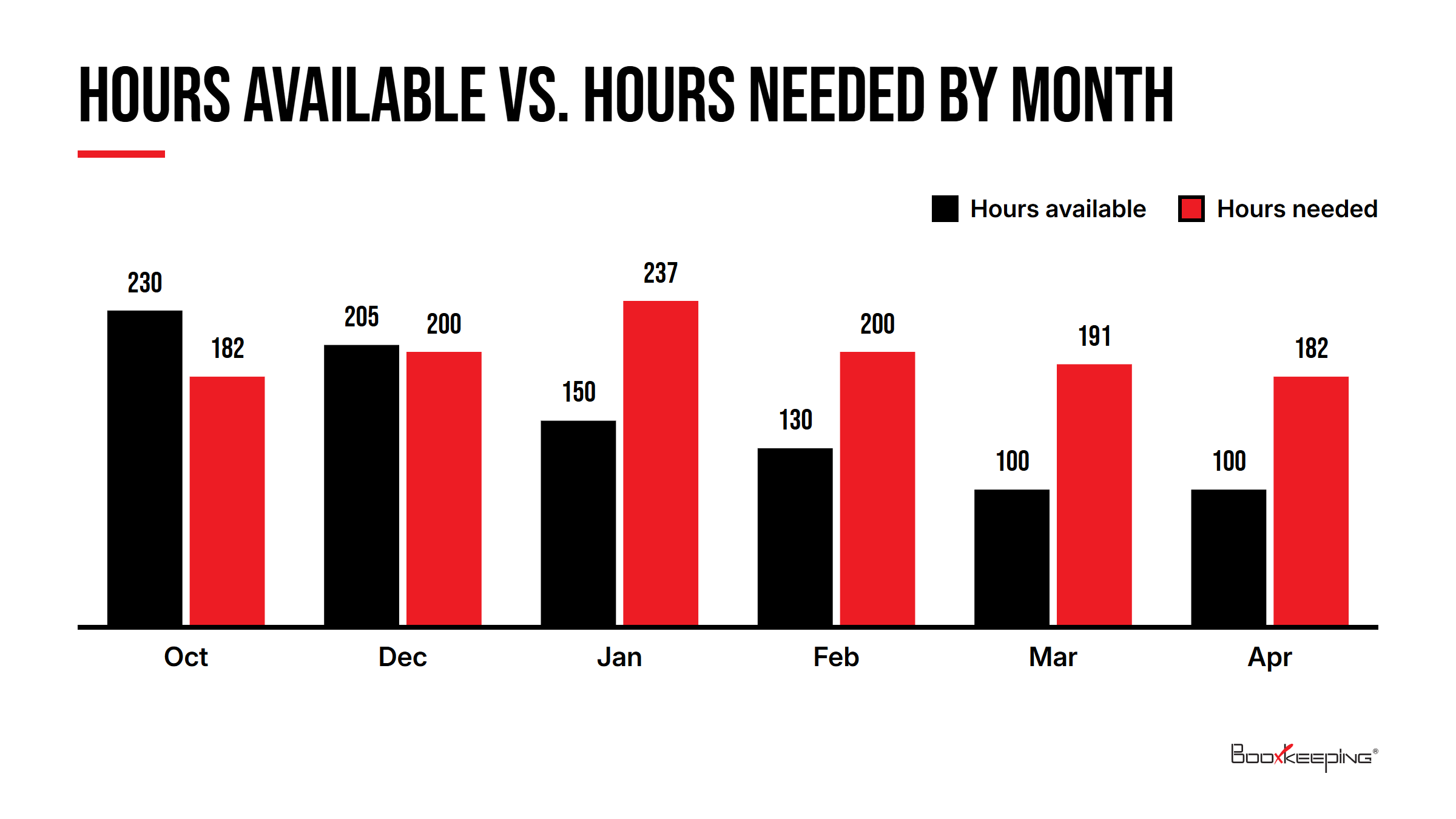
Now the supply side. The bookkeeper offers about 140 hours in a normal month, and each staff accountant gives 45 hours to bookkeeping outside of tax season, for 90 combined. Layer in the tax calendar, and the year looks like this.
| Month | Hours needed | Hours available | Load |
|---|---|---|---|
| October | 182 | 230 | 79% |
| December | 200 | 205 | 98% |
| January | 237 | 150 | 158% |
| February | 200 | 130 | 154% |
| March | 191 | 100 | 191% |
| April | 182 | 100 | 182% |
Hours needed rise in December and January for year-end cleanup and payroll and contractor reporting support. Hours available fall as the bookkeeper is pulled into return preparation and the staff accountants disappear into it.
Nobody actually works at 191 percent. What happens instead is that closes slip from the 10th to the 25th, client questions sit for a week, and cleanup gets pushed to May.
Now the ceiling math. In October, 230 hours x 0.85 = 195.5 usable hours, divided by 6.3 hours per client, gives 31 clients. In March, 100 hours x 0.85 = 85 usable hours gives 13 clients. The firm serves 29 today. In the fall it looks like it has room for two more, and in the spring it is 16 clients over. The honest number is the smaller one, unless you change the inputs.
Where quality slips first
When load runs past the ceiling, the damage follows a predictable order. Reconciliations go first: they get marked “in progress” and carried a month, then two. Next, questions to clients stop being batched, so uncategorized and suspense balances grow. Then review turns into a skim, with a partner signing off on a summary instead of checking the detail. The monthly client call gets skipped, which is exactly when a client starts wondering whether anyone is paying attention. By May you are running a catch-up bookkeeping project on your own clients, which is the least profitable work in the building.
When the math doesn’t work: hire, prune, automate, or outsource
Each option changes a different input, so test all of them against the same March number.
Hire. One full-time bookkeeper adds about 140 hours in a normal month and closes the March gap. It also drops October utilization to 49 percent (182 hours against 370 available), which means paying for a half-idle person from May through December. Hiring can still be right, especially if the new person can pick up return-preparation work in winter. The Bureau of Labor Statistics publishes an occupational outlook for accountants and auditors if you want a read on that labor market.
Prune. Reprice or release the clients who cost the most hours per dollar. It’s healthy housekeeping, but dropping 16 clients to reach the March number is not a plan.
Automate. Bank feeds, receipt capture, and rules-based categorization, with a person confirming the results, can trim production time. If they cut the 156 production hours by 15 percent, that’s about 23 hours a month. March needs 191, so automation helps at the margin and doesn’t close the gap. It shrinks production. It doesn’t shrink review, and it doesn’t change the calendar.
Outsource. Hand the production work for the 26 simple and standard clients to a white-label partner, meaning your brand, your review, their team. Your staff keeps 20 hours of review plus the three complex clients at 42 hours, so March demand on your own people falls from 191 hours to roughly 65, a 65 percent load. That leaves about 20 hours of headroom under the 85 percent line, and each new standard client costs your team roughly one review hour a month. The condition is that the partner’s capacity can’t collapse on the same calendar as yours, so ask how they staff January through April.
Planning in October for next year’s season
October is the right month to do this because the answers take time to arrive. Pull last spring’s actual hours by person and month. Sort clients into simple, standard, and complex and total the hours. Set your ceiling, then run the March calculation. If the number is short, decide by mid-November which lever you’ll pull, because a hire takes months to pay off and a partner pilot needs a couple of closes to prove itself. Start a pilot in late October and its two test closes land in November and December, ahead of the January crush.
The year-end tax planning conversations you’ll have with clients this fall are also a good moment to learn which of them are about to need more from you next year. If you’re comparing partners, how to choose a bookkeeper is a useful checklist to borrow, turned around to face the other direction. For practice-management resources, the AICPA & CIMA site is a good place to start.
Frequently asked questions
What utilization ceiling should I use?
There’s no official figure. Around 85 percent is a sensible starting point because it leaves room for questions, rework, and the client who calls on the 28th. Firms with very routine work can run higher, and firms onboarding a lot of new clients should run lower.
Do I count partner review time?
Yes, wherever it comes from. Review is real work, it happens on a deadline, and it’s usually the first thing squeezed when the calendar tightens. Counting it up front is how you discover that a “simple” client costs more than three hours.
These numbers are hypothetical. How do I get mine?
Track time on bookkeeping clients for one full month, by person and by client, then repeat the exercise in February or March. The gap between the two is your seasonality curve, and it’s more useful than any average.
Where to go from here
Run the March calculation for your own firm this week. If the answer comes out smaller than your client list, you have a few honest options, and one of them is handing production to a team that staffs for January through April. That’s what BooXkeeping’s white-label bookkeeping service is for: local owner-operators doing the monthly work behind your brand, month-to-month, with fixed monthly pricing. If you’d rather keep everything in-house, the arithmetic above still tells you what to hire for.
Most firms decide how many bookkeeping clients they can take in October, when the calendar is calm and everyone is optimistic, and find out they were wrong in March. The fix is a short piece of arithmetic: the hours a client really takes, the hours your people really have in your tightest month, and a load ceiling you’re willing to defend. This walkthrough shows the calculation with a hypothetical six-person firm, then what to do when the answer is uncomfortable.
Key takeaways
- Capacity is set by your tightest month, not your average one.
- Clients you can serve = (hours available x 0.85) divided by average hours per client, review included.
- In the example below, October supports 31 clients and March supports 13.
- Automation trims production hours. It does not fix a spring staffing gap.
- Decide by mid-November if you want a partner in place before January.
Why capacity fails in March, not in October
In October, a six-person firm has room. The last extended returns are out the door, the busy stretch is a few months away, and adding a few bookkeeping clients feels easy. What the October view can’t show is the shape of the year. Bookkeeping demand is steady, twelve months of it, with a bump at year-end. Your people’s availability isn’t steady at all. From January through April, the same staff who close the monthly ledgers are also preparing returns, answering organizer questions, and covering for each other, so the hours available for bookkeeping fall by half or more while the hours required stay put.
That’s the whole problem in one sentence: demand is flat and supply isn’t. Capacity has to be measured where supply is thinnest.
The inputs: hours per client, hours per person, and review time
You need three numbers, and all three are yours to measure, not to look up.
Hours per client. Group clients by how much work they generate rather than by how much they pay. In the hypothetical firm below, a simple client (a small LLC, one bank account, a few dozen transactions a month) takes 3 production hours. A standard client (payroll, sales tax, a few hundred transactions) takes 6. A complex client (multiple entities or locations, inventory, job costing) takes 12.
Review time. Add the hour someone senior spends checking the close: 0.5, 1, and 2 hours respectively, which makes the all-in figures 3.5, 7, and 14. This is the number most firms leave out, and it’s the one that gets squeezed first.
Hours available. For each month, count the hours each person can actually put toward bookkeeping after tax-return work, meetings, time off, and training. Use timesheets if you have them. If you don’t, this is the month to start.
Then apply a ceiling, because planning at 100 percent of available hours guarantees a miss. Unplanned work always shows up. About 85 percent is a sensible ceiling, though it’s a judgment call rather than a standard, so adjust it for your team. The formula: clients you can serve = (hours available in your tightest month x 0.85) divided by average hours per client.
A worked example: a hypothetical six-person firm
Say the firm has two partners, two staff accountants, a full-time bookkeeper, and an office manager. It serves 29 bookkeeping clients: 12 simple, 14 standard, and 3 complex. At 3.5, 7, and 14 hours all-in, that’s 42 + 98 + 42 = 182 hours a month, or about 6.3 hours per client.
Now the supply side. The bookkeeper offers about 140 hours in a normal month, and each staff accountant gives 45 hours to bookkeeping outside of tax season, for 90 combined. Layer in the tax calendar, and the year looks like this.
| Month | Hours needed | Hours available | Load |
|---|---|---|---|
| October | 182 | 230 | 79% |
| December | 200 | 205 | 98% |
| January | 237 | 150 | 158% |
| February | 200 | 130 | 154% |
| March | 191 | 100 | 191% |
| April | 182 | 100 | 182% |
Hours needed rise in December and January for year-end cleanup and payroll and contractor reporting support. Hours available fall as the bookkeeper is pulled into return preparation and the staff accountants disappear into it.
Nobody actually works at 191 percent. What happens instead is that closes slip from the 10th to the 25th, client questions sit for a week, and cleanup gets pushed to May.
Now the ceiling math. In October, 230 hours x 0.85 = 195.5 usable hours, divided by 6.3 hours per client, gives 31 clients. In March, 100 hours x 0.85 = 85 usable hours gives 13 clients. The firm serves 29 today. In the fall it looks like it has room for two more, and in the spring it is 16 clients over. The honest number is the smaller one, unless you change the inputs.
Where quality slips first
When load runs past the ceiling, the damage follows a predictable order. Reconciliations go first: they get marked “in progress” and carried a month, then two. Next, questions to clients stop being batched, so uncategorized and suspense balances grow. Then review turns into a skim, with a partner signing off on a summary instead of checking the detail. The monthly client call gets skipped, which is exactly when a client starts wondering whether anyone is paying attention. By May you are running a catch-up bookkeeping project on your own clients, which is the least profitable work in the building.
When the math doesn’t work: hire, prune, automate, or outsource
Each option changes a different input, so test all of them against the same March number.
Hire. One full-time bookkeeper adds about 140 hours in a normal month and closes the March gap. It also drops October utilization to 49 percent (182 hours against 370 available), which means paying for a half-idle person from May through December. Hiring can still be right, especially if the new person can pick up return-preparation work in winter. The Bureau of Labor Statistics publishes an occupational outlook for accountants and auditors if you want a read on that labor market.
Prune. Reprice or release the clients who cost the most hours per dollar. It’s healthy housekeeping, but dropping 16 clients to reach the March number is not a plan.
Automate. Bank feeds, receipt capture, and rules-based categorization, with a person confirming the results, can trim production time. If they cut the 156 production hours by 15 percent, that’s about 23 hours a month. March needs 191, so automation helps at the margin and doesn’t close the gap. It shrinks production. It doesn’t shrink review, and it doesn’t change the calendar.
Outsource. Hand the production work for the 26 simple and standard clients to a white-label partner, meaning your brand, your review, their team. Your staff keeps 20 hours of review plus the three complex clients at 42 hours, so March demand on your own people falls from 191 hours to roughly 65, a 65 percent load. That leaves about 20 hours of headroom under the 85 percent line, and each new standard client costs your team roughly one review hour a month. The condition is that the partner’s capacity can’t collapse on the same calendar as yours, so ask how they staff January through April.
Planning in October for next year’s season
October is the right month to do this because the answers take time to arrive. Pull last spring’s actual hours by person and month. Sort clients into simple, standard, and complex and total the hours. Set your ceiling, then run the March calculation. If the number is short, decide by mid-November which lever you’ll pull, because a hire takes months to pay off and a partner pilot needs a couple of closes to prove itself. Start a pilot in late October and its two test closes land in November and December, ahead of the January crush.
The year-end tax planning conversations you’ll have with clients this fall are also a good moment to learn which of them are about to need more from you next year. If you’re comparing partners, how to choose a bookkeeper is a useful checklist to borrow, turned around to face the other direction. For practice-management resources, the AICPA & CIMA site is a good place to start.
Frequently asked questions
What utilization ceiling should I use?
There’s no official figure. Around 85 percent is a sensible starting point because it leaves room for questions, rework, and the client who calls on the 28th. Firms with very routine work can run higher, and firms onboarding a lot of new clients should run lower.
Do I count partner review time?
Yes, wherever it comes from. Review is real work, it happens on a deadline, and it’s usually the first thing squeezed when the calendar tightens. Counting it up front is how you discover that a “simple” client costs more than three hours.
These numbers are hypothetical. How do I get mine?
Track time on bookkeeping clients for one full month, by person and by client, then repeat the exercise in February or March. The gap between the two is your seasonality curve, and it’s more useful than any average.
Where to go from here
Run the March calculation for your own firm this week. If the answer comes out smaller than your client list, you have a few honest options, and one of them is handing production to a team that staffs for January through April. That’s what BooXkeeping’s white-label bookkeeping service is for: local owner-operators doing the monthly work behind your brand, month-to-month, with fixed monthly pricing. If you’d rather keep everything in-house, the arithmetic above still tells you what to hire for.